
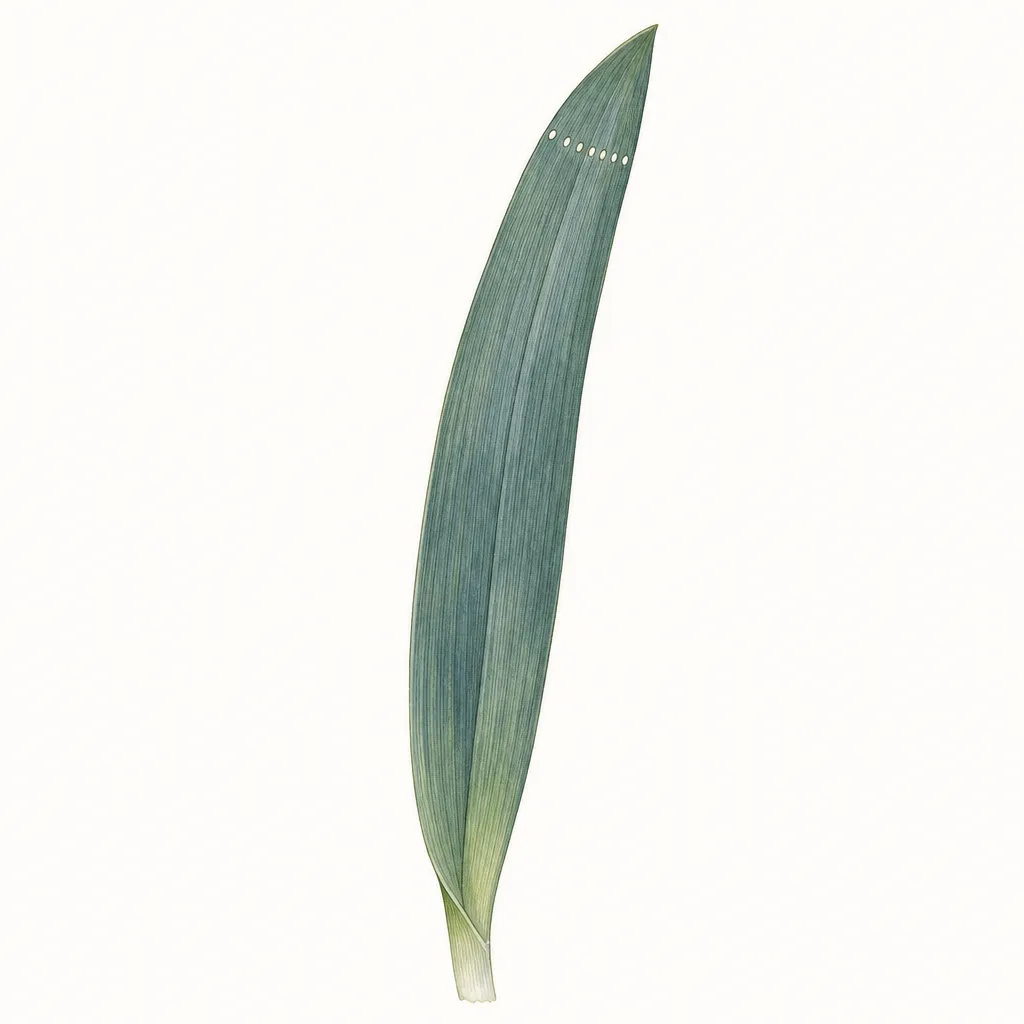
White dots in rows on leek leaves
White dots in neat rows on leek leaves most likely mean allium leafminer punctures, made by tiny flies feeding and laying eggs. ([cals.cornell.edu](https://cals.cornell.edu/integrated-pest-management/outreach-education/fact-sheets/allium-leafminer))
Not sure it's this? Scan your plant — free
What it is
Allium leafminer (Phytomyza gymnostoma) is a small fly whose young are pale maggots that feed inside onion-family plants. They tunnel down through leaves into the layered leaf bases, damaging growth and opening the way for bacterial and fungal rot. ([cals.cornell.edu](https://cals.cornell.edu/integrated-pest-management/outreach-education/fact-sheets/allium-leafminer))
Also called: Allium leaf miner, Onion leafminer
Plants affected: Leeks, Onions, Garlic, Shallots, Chives, Scallions
Symptoms
- Small, round white puncture marks in rows, often toward the middle or tip of a leaf. ([extension.umd.edu](https://extension.umd.edu/resource/leafminers-vegetables))
- Pale tunnels inside leaves, followed by curled, wavy or distorted growth. ([extension.umd.edu](https://extension.umd.edu/resource/leafminers-vegetables))
- White, legless maggots or small brown pupae between the leek's layers. ([rhs.org.uk](https://www.rhs.org.uk/biodiversity/allium-leaf-miner))
- In badly affected plants, damaged tissue becomes soft and rotten. ([rhs.org.uk](https://www.rhs.org.uk/biodiversity/allium-leaf-miner))
Causes
- Female flies puncture leaves to release sap for feeding; some punctures also contain eggs inside the leaf. ([cals.cornell.edu](https://cals.cornell.edu/integrated-pest-management/outreach-education/fact-sheets/allium-leafminer))
- Pupae can survive in old allium plants or nearby soil, providing a source for another infestation. ([cals.cornell.edu](https://cals.cornell.edu/integrated-pest-management/outreach-education/fact-sheets/allium-leafminer))
- Unprotected leeks are especially vulnerable during autumn fly activity. Timing varies with location. ([cals.cornell.edu](https://cals.cornell.edu/integrated-pest-management/outreach-education/fact-sheets/allium-leafminer))
How to tell it apart
The orderly row of round punctures is the strongest clue—not every dot is an egg. Peel back the outer layers of one badly affected leek and look for white, legless maggots or brown, barrel-shaped pupae about 3 mm long. These signs support the diagnosis more strongly than white spotting alone. ([cals.cornell.edu](https://cals.cornell.edu/integrated-pest-management/outreach-education/fact-sheets/allium-leafminer))
- Onion thrips
- Thrips cause whitish blotches and silvery streaks rather than the characteristic tidy puncture rows. Look between tightly packed leaves for tiny, thin, pale yellow-to-brown insects. ([hort.extension.wisc.edu](https://hort.extension.wisc.edu/articles/onion-thrips/?utm_source=openai))
- Leek moth
- Its caterpillars also tunnel inside leeks, but have brown heads and small legs; allium leafminer maggots lack legs and an obvious head. ([rhs.org.uk](https://www.rhs.org.uk/biodiversity/allium-leaf-miner))
Treatment
- Check how far the damage has spread This week, inspect leaf tips and examine the layers of one badly damaged leek. Check nearby onions, garlic and chives too. Look for puncture rows, internal tunnels, maggots and pupae before choosing a treatment. ([cals.cornell.edu](https://cals.cornell.edu/integrated-pest-management/outreach-education/fact-sheets/allium-leafminer))
- Remove infested crop remains Collect and discard damaged allium debris now, and clear the remaining crop debris after harvest. Do not leave infested leek layers on the bed: they can shelter pupae through winter. ([extension.umd.edu](https://extension.umd.edu/resource/leafminers-vegetables))
- Protect clean plants from further egg-laying Cover uninfested plants with insect-proof mesh or lightweight row cover, burying every edge in soil. Keep it in place throughout the local flight period—Cornell recommends about eight weeks from flight onset. Do not enclose infested plants or a bed containing pupae, which can trap emerging flies inside. Covering does not remove larvae already within leaves. ([cals.cornell.edu](https://cals.cornell.edu/integrated-pest-management/outreach-education/fact-sheets/allium-leafminer))
- Get local advice before using an insecticide If fresh puncture rows keep appearing, contact your county extension service this week about a leek-labeled insecticide and local treatment timing. Some spinosad insecticides can control this pest, but formulations and permitted uses differ. Follow the label for dose, repeat intervals, protective clothing and days before harvest; keep the product away from pets and children. ([cals.cornell.edu](https://cals.cornell.edu/integrated-pest-management/outreach-education/fact-sheets/allium-leafminer))
Prevention
- Rotate leeks and other alliums to a different bed; mesh alone cannot stop flies emerging from infested soil beneath it. ([rhs.org.uk](https://www.rhs.org.uk/biodiversity/allium-leaf-miner))
- Install covers before local spring and autumn flights begin, rather than waiting for white dots. ([extension.umd.edu](https://extension.umd.edu/resource/leafminers-vegetables))
- Remove allium crop debris after each growing season. ([extension.umd.edu](https://extension.umd.edu/resource/leafminers-vegetables))
When to worry
Act promptly if many plants develop tunnels, twisting or soft rot: internal feeding can cause substantial leek losses. A few puncture rows are an early warning, not proof that the entire crop is ruined. ([cals.cornell.edu](https://cals.cornell.edu/integrated-pest-management/outreach-education/fact-sheets/allium-leafminer))
Safety
Leeks are toxic to dogs, cats and horses. If a pet eats them, contact a veterinarian or animal poison line promptly. For any insecticide, follow the label when handling, applying and storing it; use the required protection and keep pets and children away. Store it tightly closed in its original labeled container, preferably locked away, separate from food and animal feed. ([aspca.org](https://www.aspca.org/pet-care/aspca-poison-control/toxic-and-non-toxic-plants/leek))
Sharing your home with pets or small children? See which plants our sources call safe for cats, dogs and kids.
FAQ
Are the white dots eggs?
Usually they are puncture scars. Only some punctures contain eggs, which are laid inside the leaf tissue. ([cals.cornell.edu](https://cals.cornell.edu/integrated-pest-management/outreach-education/fact-sheets/allium-leafminer))
Will cutting off the spotted tips solve it?
Do not rely on that alone: larvae tunnel downward and may already be inside the leek's lower layers. ([cals.cornell.edu](https://cals.cornell.edu/integrated-pest-management/outreach-education/fact-sheets/allium-leafminer))
Is November too late for this pest?
Not necessarily. Cornell reports autumn adults can remain active into December in the northeastern United States; local conditions affect timing. ([cals.cornell.edu](https://cals.cornell.edu/integrated-pest-management/outreach-education/fact-sheets/allium-leafminer))
Sources
- Allium Leafminer Identification, Biology and Control — Cornell IPM
- Leafminers on Vegetables — University of Maryland Extension
- Allium leaf miner — Royal Horticultural Society
- Onion Thrips — Wisconsin Horticulture
- Toxic and Non-toxic Plants: Leek — ASPCA
- Storing Pesticides Safely — US EPA
- Onion Thrips – Wisconsin Horticulture