
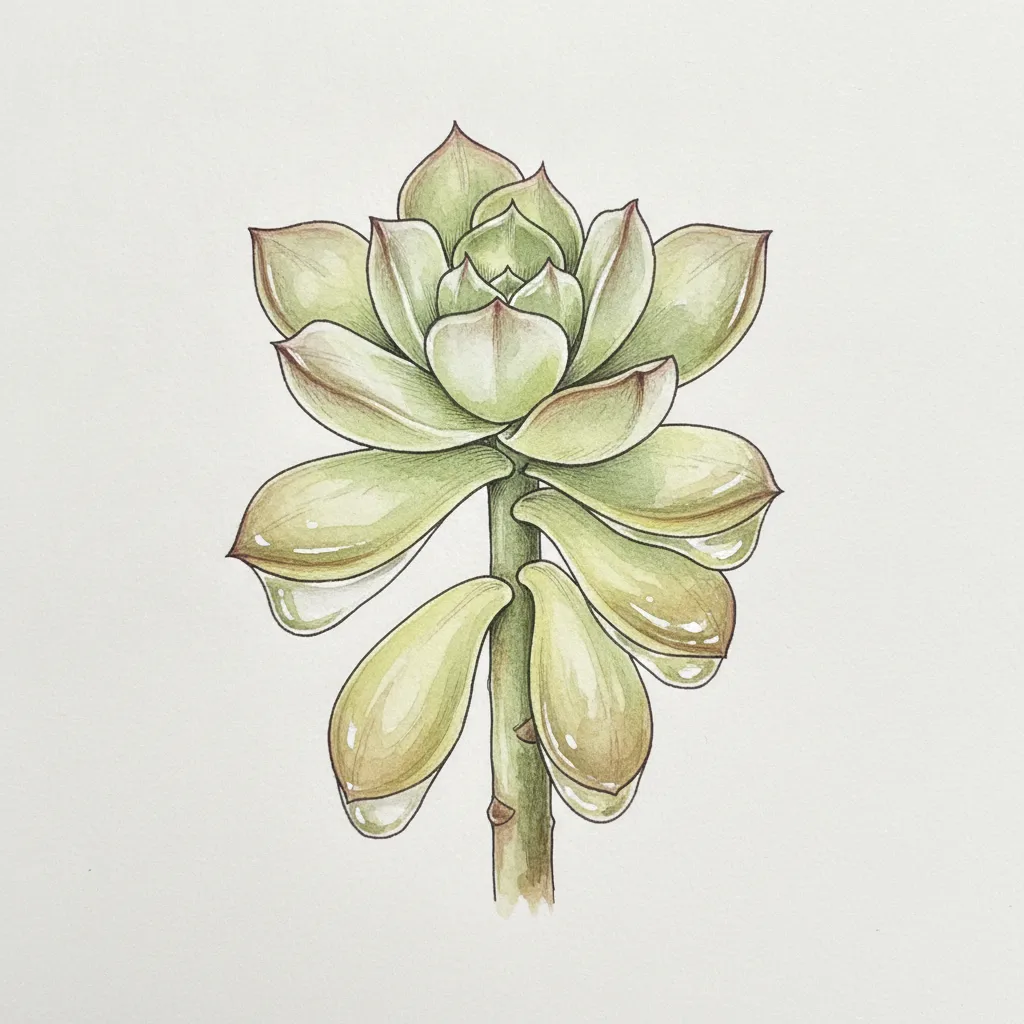
Succulent leaves turning translucent and mushy
Your succulent's leaves are most likely bursting from excess moisture caused by overwatering, poor drainage, or rotting roots.
Not sure it's this? Scan your plant — free
What it is
Edema and moisture-induced rot occur when a succulent's roots absorb moisture faster than leaves can release it through transpiration, causing internal cells to swell and rupture. This cellular breakdown leaves normally firm foliage soft, glassy, and water-soaked. If the soil remains saturated, root systems suffocate and allow secondary fungal or bacterial pathogens to decompose the plant from the roots upward.
Also called: Oedema, Waterlogging, Succulent root rot, Bacterial soft rot
Plants affected: Echeveria, Sedum, Crassula (jade plant), Haworthia, Graptopetalum, Kalanchoe, Aloe
Symptoms
- Leaves become pale, pale yellow, or see-through like green grapes
- Foliage feels squishy, soft, or watery rather than firm and plump
- Leaves drop off the stem at the slightest nudge or touch
- The main stem or base turns dark brown, black, or soft
- Roots appear dark, black, and stringy rather than pale and firm
- Potting soil stays damp for weeks, sometimes smelling sour
Causes
- Watering too frequently before the root zone has dried completely
- Dense, peat-heavy potting mix that holds moisture for too long
- Pots without drainage holes or standing water left pooling in saucers
- Inadequate light and stagnant indoor air, which slow natural water evaporation
- Freezing temperatures or cold drafts, which freeze internal moisture and burst cell walls
How to tell it apart
Check where the damage starts and how the leaves feel. Overwatering almost always begins at the base of the plant: bottom leaves turn pale, watery, and squishy, frequently falling away if you tap them. If you press a translucent leaf between two fingers, it will feel tender and moist like a peeled grape rather than leather-like or crinkled.
- Underwatering
- Underwatered leaves feel soft and look wrinkled or deflated, but they remain opaque and dry into paper-thin, crispy husks that cling to the stem rather than turning translucent and watery.
- Sunburn
- Sun damage leaves white, bleached, or dry brown patches on exposed leaf surfaces facing light, but the leaves remain firm and attached to the stem rather than mushy.
- Cold or frost damage
- Cold damage can also cause watery, collapsed leaves, but it strikes suddenly after exposure to temperatures below 45°F (7°C) and affects exposed outer leaves all at once rather than working slowly upward from the rootline.
- Bacterial soft rot
- Bacterial rot dissolves leaves and stems very rapidly into a foul-smelling, dark slime, whereas simple overwatering causes yellowing, waterlogged blisters and drop before bacterial decay sets in.
Treatment
- Stop watering and unpot the plant to inspect the roots Gently slide the succulent out of its container and shake or brush away damp soil. Inspect the root system: healthy roots are white to tan and firm, whereas rotted roots will look black, dark brown, and mushy.
- Prune away damaged leaves and rotted roots Use shears wiped with 70% isopropyl alcohol to snip off all translucent, soft leaves at the stem. Cut away any dark, decaying root strands. If the base of the stem is soft or discolored, cut the stem higher up until you see healthy, clean, firm green tissue.
- Allow wounds to callous for 2 to 4 days Lay the bare-root succulent (or stem cutting) on a dry paper towel in a bright, dry room away from direct afternoon sun. Let it air-dry for 48 to 96 hours so all cut surfaces develop a firm, dry callous.
- Repot in gritty, fast-draining cactus mix Plant the calloused succulent into a clean pot with drainage holes. Use a blend of 50% inorganic material (such as perlite, pumice, or coarse grit) and 50% potting mix to ensure rapid drainage.
- Withhold water for 7 to 10 days after repotting Do not water immediately after planting. Keep the plant in bright, indirect sunlight and give any trimmed root endings a week to 10 days to settle and recover before your first light watering.
Prevention
- Water only when the potting mix has dried completely through the entire depth of the container.
- Always choose pots with bottom drainage holes, and discard excess water from saucers within 15 minutes of watering.
- Use a gritty, porous mix containing at least 50% coarse sand, perlite, or pumice rather than standard dense potting soil.
- Provide at least 6 hours of bright light daily, using an LED plant light if natural window light is weak.
- Reduce watering frequency significantly during late autumn and winter when indoor plant growth slows.
When to worry
Worry if the main central stem turns black, soft, or emits a sour smell, or if the leaves in the growing center (crown) fall away. If the central crown has rotted completely, the base cannot recover; however, you can often save the plant by taking a clean stem cutting well above the blackened area or propagating any remaining firm, healthy green leaves.
Safety
Several popular succulents (such as jade plants, Kalanchoe, and Euphorbia species) are toxic to dogs and cats if chewed, and Euphorbia sap causes severe skin and eye irritation. If a child or pet chews on plant parts, contact your doctor, veterinarian, or a poison control center right away. If using rubbing alcohol to sanitize pruning tools, store the product out of reach of children and pets, use it in a well-ventilated space, and follow all package precautions.
Sharing your home with pets or small children? See which plants our sources call safe for cats, dogs and kids.
FAQ
Can translucent succulent leaves turn back to normal?
No. Once a leaf turns translucent, its internal cells have burst and cannot repair themselves. Gently pluck those leaves off so the succulent can direct energy toward new, healthy growth.
How often should I water an indoor succulent?
Avoid watering on a fixed calendar schedule. Instead, check the soil with a wooden skewer or moisture probe, watering deeply only when the pot has dried completely to the bottom—typically every 2 to 4 weeks depending on temperature, season, and pot material.
Can I propagate a mushy, see-through succulent leaf?
No. Translucent leaves have broken cellular walls and will decay into rot rather than produce roots. Only propagate from leaves that are completely firm, undamaged, and green.
Why are leaves turning mushy if I only water once a week?
For most indoor succulents, once a week is too frequent. Low indoor humidity, lack of strong sunlight, and dense soil mean moisture stays trapped around roots for weeks, starving them of oxygen and causing leaf cells to rupture.