
Orchid crown turning black: causes and next steps
An orchid crown turning black is most likely crown rot, especially if the center is soft or wet; separate the plant and dry the crown promptly. ([aos.org](https://www.aos.org/orchids/articles/growing-phalaenopsis.-what-can-go-wrong))
Not sure it's this? Scan your plant — free
What it is
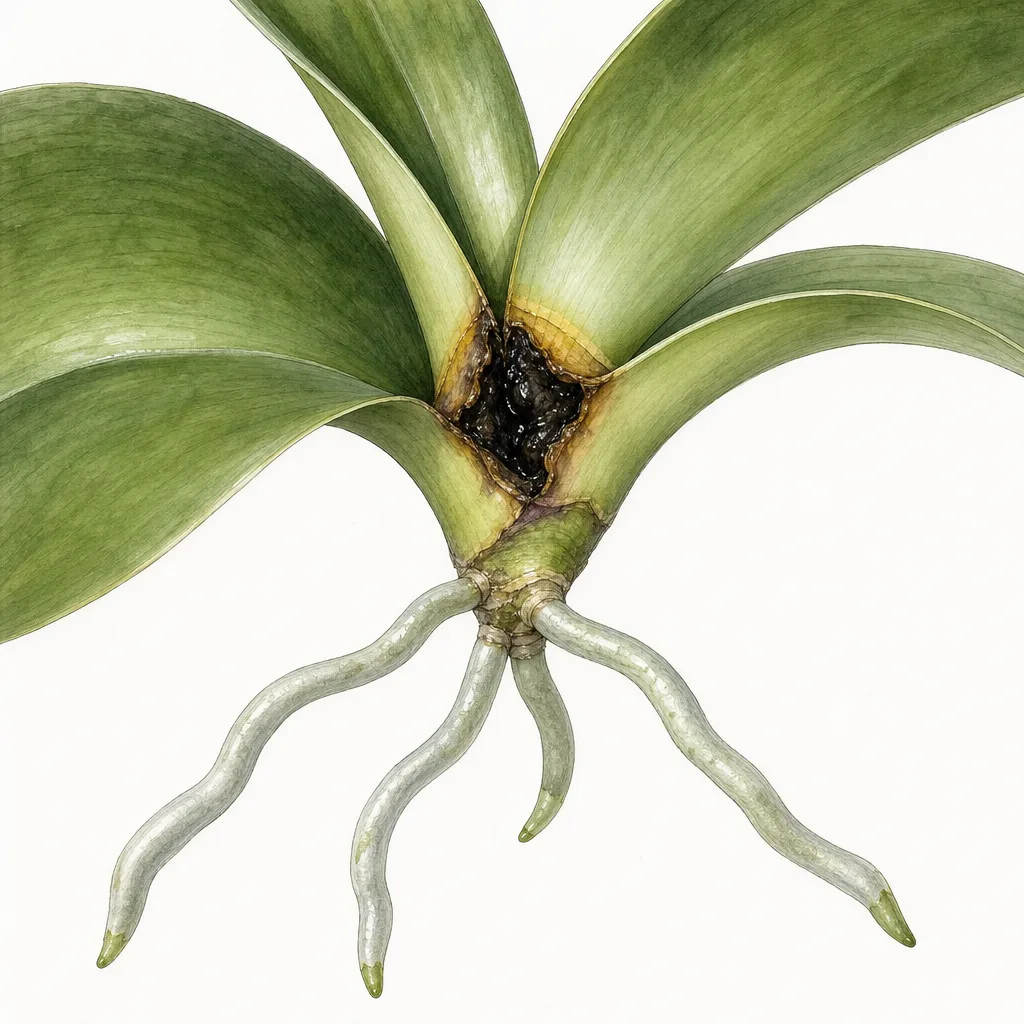
Crown rot is decay of the growing point where an orchid produces new leaves. Bacteria or fungus-like water molds can destroy this tissue; a moth orchid whose growing tip dies cannot produce replacement leaves from that tip. ([aos.org](https://www.aos.org/orchids/articles/growing-phalaenopsis.-what-can-go-wrong))
Also called: Crown rot, Heart rot
Plants affected: Phalaenopsis (moth orchids), Vanda and other single-stemmed orchids
Symptoms
- Brown-to-black, soft or water-soaked tissue in the center where new leaves emerge. ([aos.org](https://www.aos.org/orchids/articles/growing-phalaenopsis.-what-can-go-wrong))
- Dark areas that enlarge rapidly, sometimes with yellow edges. ([aos.org](https://www.aos.org/orchid-care/orchid-pests-and-diseases/black-rot))
- A foul smell with some bacterial soft rots; no smell does not establish a different diagnosis. ([aos.org](https://www.aos.org/orchids/articles/growing-phalaenopsis.-what-can-go-wrong))
Causes
- Water collecting between the leaves and remaining in the crown, allowing bacteria to multiply. ([aos.org](https://www.aos.org/orchids/articles/growing-phalaenopsis.-what-can-go-wrong))
- Water-mold infection spread through contaminated water, splashing, pots or potting material. ([aos.org](https://www.aos.org/orchid-care/orchid-pests-and-diseases/water-molds))
- Leaves staying wet for extended periods, particularly where air movement is poor. ([aos.org](https://www.aos.org/orchid-care/orchid-pests-and-diseases/black-rot))
How to tell it apart
Look into the center where the newest leaves emerge, rather than at the flower stalk. Blackening there with soft, wet tissue strongly suggests rot, but color alone cannot identify the cause. Orchid references use 'crown rot' for both bacterial decay and water-mold disease, so the name does not establish which treatment product is appropriate. ([aos.org](https://www.aos.org/orchids/articles/growing-phalaenopsis.-what-can-go-wrong))
- Sunburn
- Damage appears on the most sun-exposed part of a leaf and may fade into a thin, tan scar, rather than starting inside the crown. ([aos.org](https://www.aos.org/orchids/articles/growing-phalaenopsis.-what-can-go-wrong))
- Cold injury
- Pitting, sunken patches and water-soaked browning follow cold exposure; damaged tissue can later develop rot too. ([aos.org](https://www.aos.org/orchids/articles/growing-phalaenopsis.-what-can-go-wrong))
- Root rot
- Damage begins in the roots, with wilting or wrinkled leaves and brown-to-black roots, rather than initially at the top growing point. ([aos.org](https://www.aos.org/orchid-care/whats-wrong-with-my-orchid))
Treatment
- Separate the orchid now Move it away from healthy plants today. Prevent its watering runoff or splashes from reaching other pots; water can spread these infections. ([aos.org](https://www.aos.org/orchid-care/orchid-pests-and-diseases/black-rot))
- Remove trapped water Gently tilt the plant to drain the crown, then wick remaining droplets out with a paper-towel corner. Repeat whenever water gets between the leaves. Give the plant good air circulation so wet surfaces dry promptly. ([aos.org](https://www.aos.org/orchids/articles/growing-phalaenopsis.-what-can-go-wrong))
- Remove accessible infected leaf tissue If decay is confined to a leaf, use a sterile cutting tool to remove the affected portion, including a small margin of healthy tissue, or remove the whole affected leaf. This is an early-intervention measure before rot reaches the crown—not a reliable rescue for an already destroyed growing point. Let the cut dry with good airflow. ([aos.org](https://www.aos.org/orchid-care/orchid-pests-and-diseases/black-rot))
- Match any treatment product to the disease Before buying a product this week, ask an extension service or orchid society for diagnostic help. Bacterial rots and water-mold rots require different product choices. Use a bactericide or fungicide only if its label permits the plant, disease and indoor setting; follow the label for dilution, application and repeat timing, and keep it away from pets and children. ([aos.org](https://www.aos.org/orchids/articles/growing-phalaenopsis.-what-can-go-wrong))
- Water the roots without wetting the crown At the next needed watering, direct lukewarm water onto the potting medium in the morning and let the pot drain completely. Do not leave it standing in runoff. Dry any crown splashes immediately. ([missouribotanicalgarden.org](https://www.missouribotanicalgarden.org/gardens-gardening/your-garden/help-for-the-home-gardener/advice-tips-resources/visual-guides/phalaenopsis?utm_source=openai))
Prevention
- Water in the morning so leaves can dry before nightfall. ([missouribotanicalgarden.org](https://www.missouribotanicalgarden.org/gardens-gardening/your-garden/help-for-the-home-gardener/advice-tips-resources/visual-guides/phalaenopsis?utm_source=openai))
- After every watering, check the leaf pockets and wick away trapped water. ([missouribotanicalgarden.org](https://www.missouribotanicalgarden.org/gardens-gardening/your-garden/help-for-the-home-gardener/advice-tips-resources/visual-guides/phalaenopsis?utm_source=openai))
- Maintain air movement and avoid splashing water between orchids. ([aos.org](https://www.aos.org/orchid-care/orchid-pests-and-diseases/black-rot))
When to worry
Act today if the black area is soft, spreading or foul-smelling: bacterial soft rot can destroy an orchid in two to three days. Once the growing point is destroyed, recovery is uncertain; some moth orchids may produce a new plantlet below the damaged crown. ([aos.org](https://www.aos.org/orchids/articles/growing-phalaenopsis.-what-can-go-wrong))
Safety
Handle cutting tools carefully and keep them away from children and pets. For any treatment product, follow the label, including protective equipment and instructions for keeping people and pets away during and after application. Store it tightly closed in its original labeled container, out of their reach. For suspected exposure, contact a doctor, veterinarian or poison line and have the label available. ([epa.gov](https://www.epa.gov/safepestcontrol/storing-pesticides-safely?utm_source=openai))
Sharing your home with pets or small children? See which plants our sources call safe for cats, dogs and kids.
FAQ
Can an orchid survive crown rot?
Sometimes, but not reliably. A moth orchid may grow a new plantlet below the damaged crown if it has enough reserves. ([aos.org](https://www.aos.org/orchids/articles/growing-phalaenopsis.-what-can-go-wrong))
Will the black crown turn green again?
A destroyed growing tip cannot resume making leaves; any recovery depends on surviving growth below it. ([aos.org](https://www.aos.org/orchids/articles/growing-phalaenopsis.-what-can-go-wrong))
Can it spread to my other orchids?
Yes. Infected water and splashes can spread bacterial and water-mold rots, so isolate the affected plant. ([aos.org](https://www.aos.org/orchid-care/whats-wrong-with-my-orchid))
Sources
- American Orchid Society: Growing Phalaenopsis. What Can Go Wrong?
- American Orchid Society: Water Molds
- American Orchid Society: Black Rot
- Missouri Botanical Garden: Phalaenopsis
- American Orchid Society: What's wrong with my orchid?
- Penn State Extension: What You Need to Know about Reading a Pesticide Label
- Phalaenopsis
- Storing Pesticides Safely | US EPA