
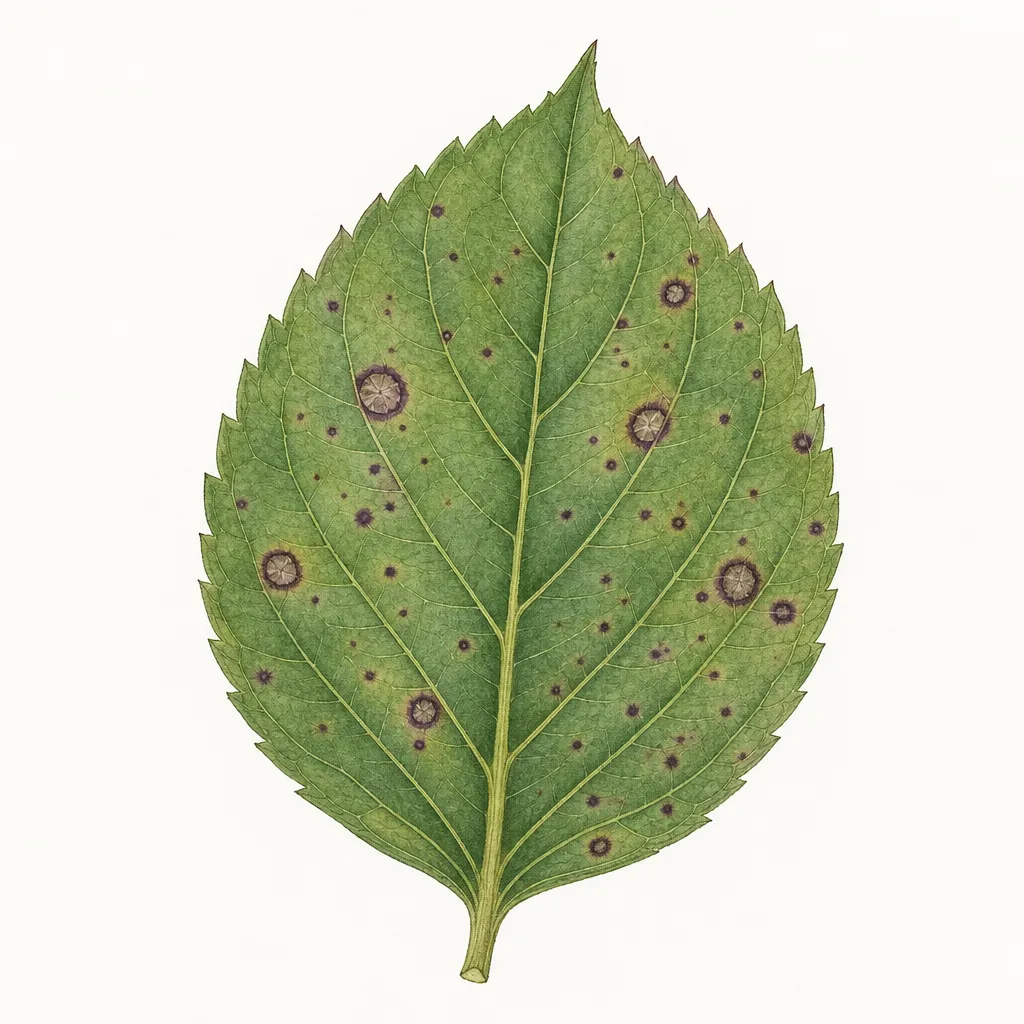
Hydrangea leaves with purple and brown spots
Purple and brown spots on hydrangea leaves most likely mean Cercospora leaf spot, a common fungal disease that usually spoils the leaves rather than kills the shrub. ([uaex.uada.edu](https://www.uaex.uada.edu/publications/pdf/FSA-7570.pdf))
Not sure it's this? Scan your plant — free
What it is
Cercospora leaf spot is an infectious leaf disease caused by a fungus. It damages patches of leaf tissue; severe, repeated infections can cause early leaf loss and weaken the plant. Smooth, panicle, oakleaf and bigleaf hydrangeas can all be affected. ([uaex.uada.edu](https://www.uaex.uada.edu/publications/pdf/FSA-7570.pdf))
Also called: Fungal leaf spot of hydrangea
Plants affected: Bigleaf hydrangea, Oakleaf hydrangea, Smooth hydrangea, Panicle hydrangea
Symptoms
- Small, round purple-to-brown spots, often appearing on older, lower leaves first. ([apps.extension.umn.edu](https://apps.extension.umn.edu/garden/diagnose/plant/deciduous/hydrangea/spotsorblotches.html))
- Older spots develop tan or gray centers surrounded by dark purple or brown borders. ([hyg.ipm.illinois.edu](https://hyg.ipm.illinois.edu/article.php?id=1311&utm_source=openai))
- Heavily spotted leaves turn yellow-green and may fall early. ([hyg.ipm.illinois.edu](https://hyg.ipm.illinois.edu/article.php?id=1311&utm_source=openai))
Causes
- The fungus survives in infected leaf debris, providing a source of future infections. ([hyg.ipm.illinois.edu](https://hyg.ipm.illinois.edu/article.php?id=1311&utm_source=openai))
- Splashing rain and overhead watering move fungal spores onto leaves. ([hyg.ipm.illinois.edu](https://hyg.ipm.illinois.edu/article.php?id=1311&utm_source=openai))
- Crowded planting and slow-drying foliage favor disease spread. ([hyg.ipm.illinois.edu](https://hyg.ipm.illinois.edu/article.php?id=1311&utm_source=openai))
How to tell it apart
Look for separate spots with pale centers and purple borders, especially on lower leaves, becoming noticeable in late summer or fall. This pattern supports Cercospora, but color alone cannot confirm it: bacterial leaf spot can also make purple-brown marks, particularly on oakleaf hydrangeas. ([extension.umd.edu](https://extension.umd.edu/resource/hydrangea-identify-and-manage-problems))
- Bacterial leaf spot
- Especially suspect this on oakleaf hydrangeas when spotting starts during warm, wet weather in late spring or early summer. Its purple-brown spots overlap with fungal symptoms, so an extension diagnosis may be needed. ([extension.umd.edu](https://extension.umd.edu/resource/hydrangea-identify-and-manage-problems))
- Anthracnose
- Look for larger, slightly sunken brown spots with concentric dark rings, giving a bull's-eye appearance. Spots may reach about 1 inch across and affect flower petals too. ([apps.extension.umn.edu](https://apps.extension.umn.edu/garden/diagnose/plant/deciduous/hydrangea/spotsorblotches.html))
- Powdery mildew
- Purple blotches come with white, powdery growth; leaves may curl, pucker or remain small. Check both leaf surfaces. ([apps.extension.umn.edu](https://apps.extension.umn.edu/garden/diagnose/plant/deciduous/hydrangea/spotsorblotches.html))
- Leaf scorch
- Browning begins along leaf edges, which become dry and crispy, rather than forming scattered purple-bordered spots. Too much sun can cause this damage. ([extension.umd.edu](https://extension.umd.edu/resource/hydrangea-identify-and-manage-problems))
Treatment
- Collect infected fallen leaves Clear spotted leaves from beneath the shrub this week, and repeat as more fall. Remove this debris before fresh leaves emerge in spring to reduce surviving fungus. ([uaex.uada.edu](https://www.uaex.uada.edu/publications/pdf/FSA-7570.pdf))
- Stop wetting the foliage At the next needed watering, use a soaker hose or drip irrigation at soil level instead of a sprinkler. Keep this approach for every watering; splashes spread spores between leaves. ([hyg.ipm.illinois.edu](https://hyg.ipm.illinois.edu/article.php?id=1311&utm_source=openai))
- Help leaves dry faster This week, move any crowded neighboring containers farther apart so foliage is not pressed together and air can move between plants. Better spacing helps leaves dry after rain. ([hyg.ipm.illinois.edu](https://hyg.ipm.illinois.edu/article.php?id=1311&utm_source=openai))
- Do not rush to spray For ordinary late-season spotting, cleanup is usually enough. If severe leaf loss returns every year, contact your local extension office this week about diagnosis and whether a protective fungicide is justified. Such treatments work best before or when spots first appear, not as a late-season rescue. Follow the label and keep any fungicide away from pets and children. ([uaex.uada.edu](https://www.uaex.uada.edu/publications/pdf/FSA-7570.pdf))
Prevention
- Keep fallen infected leaves cleared away, especially before spring growth. ([uaex.uada.edu](https://www.uaex.uada.edu/publications/pdf/FSA-7570.pdf))
- Water the soil rather than the leaves and allow adequate space between plants for airflow. ([hyg.ipm.illinois.edu](https://hyg.ipm.illinois.edu/article.php?id=1311&utm_source=openai))
When to worry
A few spotted leaves late in the season are usually not an emergency. Seek an extension diagnosis if the shrub repeatedly loses many leaves or grows and flowers less vigorously; severe recurring disease can weaken it. A laboratory examination may be needed to distinguish similar diseases. ([hyg.ipm.illinois.edu](https://hyg.ipm.illinois.edu/article.php?id=1311&utm_source=openai))
Safety
Hydrangea is not edible and can harm people if swallowed; keep plant material away from children and pets. Contact a doctor or poison line after suspected human ingestion, or a veterinarian after suspected pet ingestion. If using any garden product, follow its label, including protective clothing, handling and disposal instructions. Store it tightly closed in its original labeled container, inaccessible to children and pets, and keep them away from treated areas as directed. ([plants.ces.ncsu.edu](https://plants.ces.ncsu.edu/plants/hydrangea-macrophylla/))
Sharing your home with pets or small children? See which plants our sources call safe for cats, dogs and kids.
FAQ
Will leaf spot kill my hydrangea?
Usually not. It is mainly a cosmetic problem, although severe repeated leaf loss can reduce vigor and flowering. ([hyg.ipm.illinois.edu](https://hyg.ipm.illinois.edu/article.php?id=1311&utm_source=openai))
Can it spread to nearby hydrangeas?
Yes. Splashing rain or sprinkler water can carry spores to other foliage. ([hyg.ipm.illinois.edu](https://hyg.ipm.illinois.edu/article.php?id=1311&utm_source=openai))
Do I need a fungicide?
Usually not for mild, late-season spotting. Some extension references reserve fungicides for severe recurring cases rather than routine treatment. ([uaex.uada.edu](https://www.uaex.uada.edu/publications/pdf/FSA-7570.pdf))
Could purple leaves just be fall color?
Yes, especially on oakleaf hydrangeas, which naturally develop burgundy or plum-red fall foliage. Distinct tan-centered spots with purple borders point more toward leaf spot. ([extension.umd.edu](https://extension.umd.edu/resource/hydrangea-identify-and-manage-problems))
Sources
- Cercospora Leaf Spot of Hydrangea — University of Arkansas Extension
- Hydrangea: Identify and Manage Problems — University of Maryland Extension
- Hydrangea: Spots or Blotches on Leaves — University of Minnesota Extension
- Hydrangea macrophylla — NC State Extension Gardener Plant Toolbox
- Do's and Don'ts of Pest Control — US EPA