
Gray aphids on cabbage leaves: causes and fixes
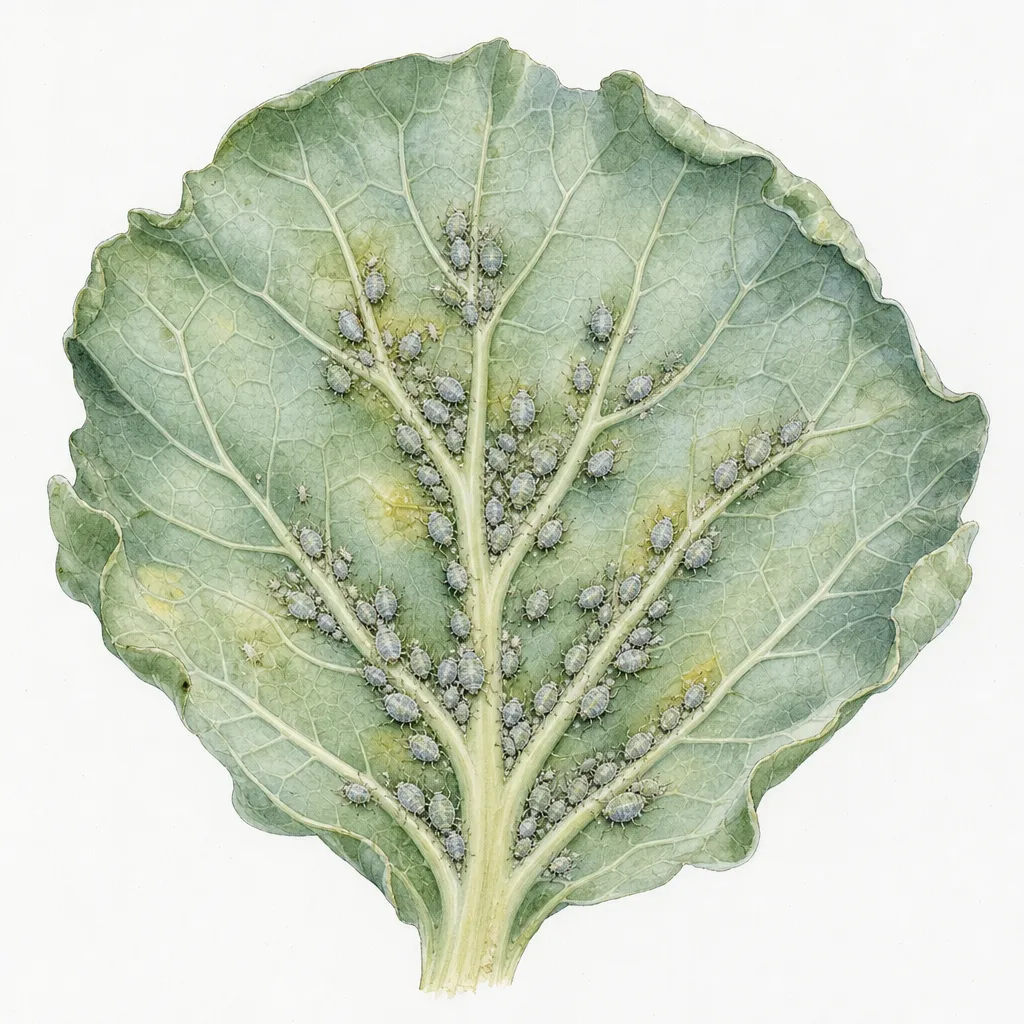
Gray, dusty-looking clusters on cabbage leaves are most likely cabbage aphids; start by washing exposed colonies off with a firm stream of water and checking inside curled leaves. ([ipm.ucanr.edu](https://ipm.ucanr.edu/agriculture/cole-crops/cabbage-aphid/?utm_source=openai))
Not sure it's this? Scan your plant — free
What it is
The cabbage aphid is a small, soft-bodied insect that feeds on mustard-family plants using piercing, sap-sucking mouthparts. Its feeding can curl and yellow leaves, slow growth, and leave dense colonies inside developing heads. ([ipm.ucanr.edu](https://ipm.ucanr.edu/home-and-landscape/aphids/))
Also called: Cabbage aphid infestation, Brevicoryne brassicae
Plants affected: Cabbage, Broccoli, Cauliflower, Brussels sprouts, Other mustard-family crops and weeds
Symptoms
- Dense groups of gray-green insects with a dusty white or gray wax coating, especially underneath leaves. ([umass.edu](https://www.umass.edu/agriculture-food-environment/vegetable/fact-sheets/cabbage-aphid))
- Wrinkled, downward-curling or yellow leaves and reduced growth. ([umass.edu](https://www.umass.edu/agriculture-food-environment/vegetable/fact-sheets/cabbage-aphid))
- Colonies tucked into young inner leaves or deep inside cabbage heads. ([ipm.ucanr.edu](https://ipm.ucanr.edu/agriculture/cole-crops/cabbage-aphid/?utm_source=openai))
- Sticky honeydew on infested growth. ([umass.edu](https://www.umass.edu/agriculture-food-environment/vegetable/fact-sheets/cabbage-aphid))
Causes
- Winged aphids arrive on plants and establish colonies that can multiply quickly. ([umass.edu](https://www.umass.edu/agriculture-food-environment/vegetable/fact-sheets/cabbage-aphid))
- Infested transplants, leftover brassica crops and mustard-family weeds can help carry the pest between plantings. ([ipm.ucanr.edu](https://ipm.ucanr.edu/agriculture/cole-crops/cabbage-aphid/?utm_source=openai))
- Cool weather can favor population growth, making long-season fall crops especially vulnerable. ([umass.edu](https://www.umass.edu/agriculture-food-environment/vegetable/fact-sheets/cabbage-aphid))
How to tell it apart
Turn over affected leaves and inspect the youngest inner growth with a hand lens. Look for separate, pear-shaped insects beneath the dusty coating, with legs, antennae and two short projections at the rear; younger cabbage aphids may be brighter green and less waxy. This combination on cabbage strongly suggests cabbage aphids. ([extension.usu.edu](https://extension.usu.edu/planthealth/research/aphid-pests-on-vegetables))
- Green peach aphids
- These also infest cabbage but are usually yellow-green, green, pink or red rather than covered in the cabbage aphid's dusty wax. Color alone is not a reliable identification. ([extension.usu.edu](https://extension.usu.edu/planthealth/research/aphid-pests-on-vegetables))
- Shed aphid skins
- White skins scattered around a colony are leftovers from molting, not additional living aphids. Look nearby for live insects before deciding treatment is still needed. ([extension.usu.edu](https://extension.usu.edu/planthealth/research/aphid-pests-on-vegetables))
- Parasitized aphid mummies
- Swollen bronze or brown aphid bodies, sometimes with a round exit hole, indicate beneficial parasitic wasps rather than a growing live colony. ([umass.edu](https://www.umass.edu/agriculture-food-environment/vegetable/fact-sheets/cabbage-aphid))
Treatment
- Wash off exposed colonies Today, support sturdy leaves and direct a firm stream of plain water at the insects, including leaf undersides. Use enough pressure to dislodge them without tearing the foliage. Inspect again twice this week and repeat if exposed colonies remain. ([ipm.ucanr.edu](https://ipm.ucanr.edu/home-and-landscape/aphids/))
- Remove leaves that shelter dense colonies If the infestation is confined to a few outer leaves, remove those leaves now, especially tightly curled ones that hide insects from water or contact sprays. If one young plant is heavily infested while neighboring plants are clean, remove that plant. ([ipm.ucanr.edu](https://ipm.ucanr.edu/home-and-landscape/aphids/))
- Protect the insects helping you During each inspection, look for ladybugs, hoverfly larvae and aphid mummies. Avoid broad-spectrum insecticides, and do not spray these helpers directly. They can suppress colonies, although they may not control a severe infestation by themselves. ([ipm.ucanr.edu](https://ipm.ucanr.edu/home-and-landscape/aphids/))
- Use insecticidal soap only if colonies persist Choose a commercial insecticidal soap labeled for aphids on edible cabbage. Test a small patch and wait several days before wider use; cabbage can suffer soap injury. Wet the aphids directly, including underneath leaves, using the label's dilution and repeat interval. Avoid drought-stressed plants and temperatures above 90°F. Follow the label, including harvest restrictions, and keep the product and treated area away from pets and children as directed. Do not substitute dish detergent or mix home remedies. ([ipm.ucanr.edu](https://ipm.ucanr.edu/agriculture/cole-crops/cabbage-aphid/?utm_source=openai))
- Recheck the developing head At your next inspection this week, gently pull back loose wrapper leaves and check for live aphids. Act promptly if they are entering the head: hidden colonies are difficult to reach, and insecticidal soap provides only partial control. ([ipm.ucanr.edu](https://ipm.ucanr.edu/agriculture/cole-crops/cabbage-aphid/?utm_source=openai))
Prevention
- Inspect transplants before planting and avoid introducing infested plants. ([ipm.ucanr.edu](https://ipm.ucanr.edu/agriculture/cole-crops/cabbage-aphid/?utm_source=openai))
- Remove mustard-family weeds and clear crop remains promptly after harvest. ([ipm.ucanr.edu](https://ipm.ucanr.edu/agriculture/cole-crops/cabbage-aphid/?utm_source=openai))
- Check leaf undersides and inner growth at least twice weekly, particularly as heads begin forming. ([ipm.ucanr.edu](https://ipm.ucanr.edu/agriculture/cole-crops/cabbage-aphid/?utm_source=openai))
- Avoid excessive nitrogen feeding, which encourages tender growth attractive to aphids. ([ipm.ucanr.edu](https://ipm.ucanr.edu/home-and-landscape/aphids/))
When to worry
Give this prompt attention if colonies reach the developing head, leaves become badly distorted, or a small plant stops growing. Extension recommendations differ on numerical treatment thresholds, but agree that infestations become harder to manage once harvestable parts develop; do not wait for a head to fill with aphids. ([ipm.ucanr.edu](https://ipm.ucanr.edu/agriculture/cole-crops/cabbage-aphid/?utm_source=openai))
Safety
Insecticidal soap is a pesticide, even though it is relatively low-risk. Follow every label direction, wear the specified protective equipment, and observe the stated harvest and re-entry intervals. Store it tightly closed in its original labeled container in a locked area away from children, pets, food and animal feed. For accidental exposure, follow the label's first-aid instructions and have the label available when contacting a doctor, veterinarian or poison line. ([extension.umd.edu](https://www.extension.umd.edu/resource/aphids-home-gardens))
Sharing your home with pets or small children? See which plants our sources call safe for cats, dogs and kids.
FAQ
Why do cabbage aphids look gray?
Their bodies are gray-green, but a dusty wax coating often makes them look gray or white. ([umass.edu](https://www.umass.edu/agriculture-food-environment/vegetable/fact-sheets/cabbage-aphid))
Will one spray get rid of them?
Not necessarily. Contact sprays must hit the insects, and missed aphids can multiply quickly; recheck and repeat only at the label's permitted interval. ([extension.umd.edu](https://www.extension.umd.edu/resource/aphids-home-gardens))
Can I use dish soap?
Use a labeled insecticidal soap instead. University of Maryland Extension advises against household soaps, detergents and homemade spray mixtures. ([extension.umd.edu](https://www.extension.umd.edu/resource/aphids-home-gardens))
Will ladybugs solve the problem?
They can help reduce aphids, but natural enemies may not control severe colonies or insects hidden deep inside cabbage heads. ([ipm.ucanr.edu](https://ipm.ucanr.edu/agriculture/cole-crops/cabbage-aphid/?utm_source=openai))
Sources
- Cabbage Aphid — UC IPM
- Aphids — UC IPM
- Cabbage Aphid — UMass Amherst
- Aphids on Vegetables — Utah State University Extension
- Aphids in Home Gardens — University of Maryland Extension
- What You Need to Know about Reading a Pesticide Label — Penn State Extension
- Cabbage Aphid / Cole Crops / Agriculture: Pest Management Guidelines / UC Statewide IPM Program (UC IPM)