
Black spots on holly leaves: causes and fixes
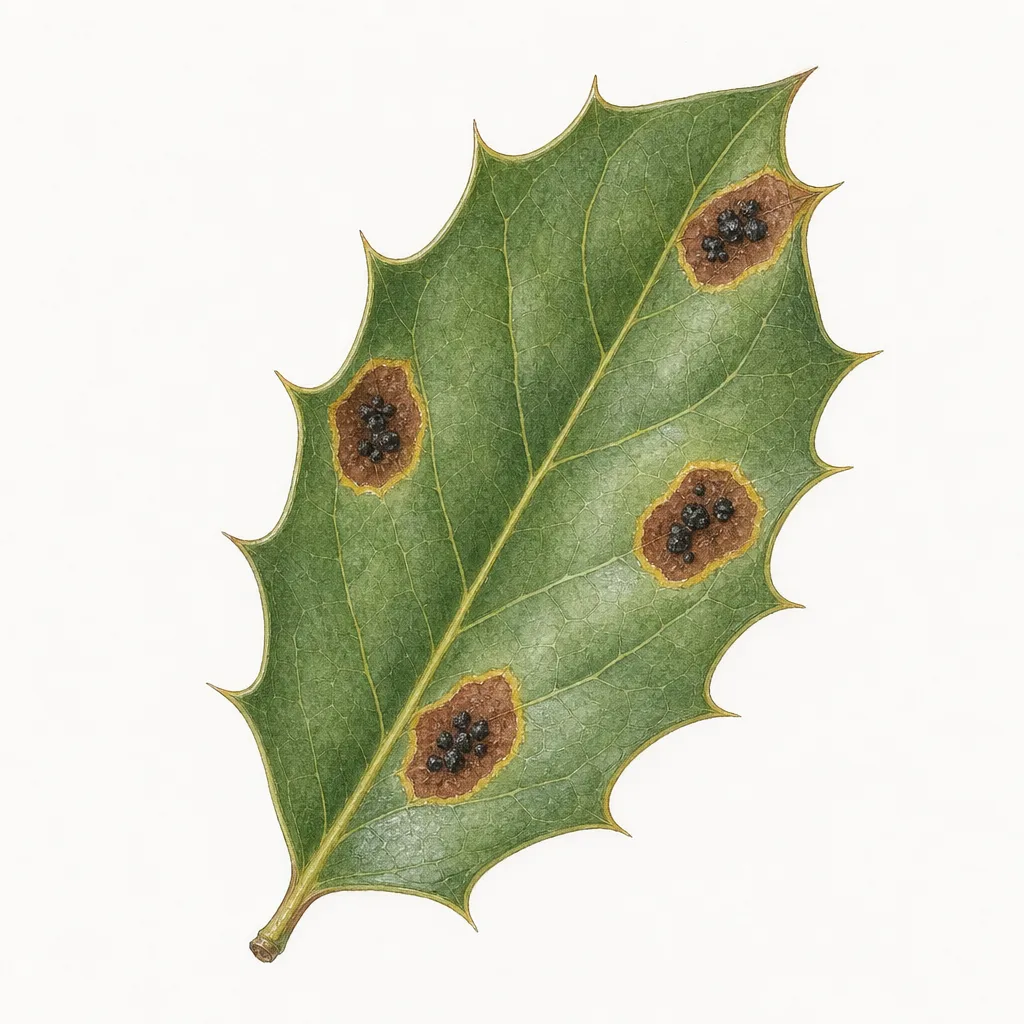
Distinct black spots within holly leaves are most likely a fungal leaf spot such as tar spot, usually a cosmetic problem rather than a threat to the shrub. ([hgic.clemson.edu](https://hgic.clemson.edu/factsheet/holly-diseases-insect-pests/))
Not sure it's this? Scan your plant — free
What it is
Tar spot is a fungal disease of holly foliage. Infection produces discolored patches where black fungal structures develop; the damage is generally cosmetic rather than life-threatening. ([extension.psu.edu](https://extension.psu.edu/holly-diseases?utm_source=openai))
Also called: Tar spot of holly, Fungal leaf spot
Plants affected: Hollies (Ilex species), particularly American and English holly. ([hgic.clemson.edu](https://hgic.clemson.edu/factsheet/holly-diseases-insect-pests/))
Symptoms
- Small yellow spots that become reddish-brown, then black by fall. ([hgic.clemson.edu](https://hgic.clemson.edu/factsheet/holly-diseases-insect-pests/))
- Black, cushion-like fungal structures within affected patches, sometimes with a yellow border. ([extension.psu.edu](https://extension.psu.edu/holly-diseases?utm_source=openai))
- Otherwise healthy-looking growth: extensive leaf loss is not typical of uncomplicated tar spot. ([pddc.wisc.edu](https://pddc.wisc.edu/wp-content/blogs.dir/39/files/Fact_Sheets/FC_PDF/Tar_Spot_of_Trees_and_Shrubs.pdf))
Causes
- Fungal infection of the foliage; several fungi cause leaf spots on holly, so appearance alone cannot confirm the exact organism. ([hort.ifas.ufl.edu](https://hort.ifas.ufl.edu/trees/ILEOPAA.pdf?utm_source=openai))
- Infected fallen leaves and crowded growth are targets for tar spot management: cleanup and better air circulation help reduce disease pressure. ([hgic.clemson.edu](https://hgic.clemson.edu/factsheet/holly-diseases-insect-pests/))
How to tell it apart
Look for separate spots that changed from yellow or reddish-brown to black, rather than a soot-like surface coating. Black or purple blotches accompanied by falling leaves and blackened twigs point toward holly leaf blight instead. These clues narrow the possibilities but do not confirm a diagnosis. ([hgic.clemson.edu](https://hgic.clemson.edu/factsheet/holly-diseases-insect-pests/))
- Sooty mold
- A black, soot-like coating grows on sticky honeydew left by sap-feeding insects. Check leaf undersides and stems for soft scales or other insects; this mold grows on the surface rather than infecting leaf tissue. ([extension.umd.edu](https://extension.umd.edu/resource/honeydew-and-sooty-mold))
- Holly leaf blight
- Black or purple blotches, premature leaf fall and blackened small stems, especially after cool, wet weather, suggest this more damaging disease. ([rhs.org.uk](https://www.rhs.org.uk/disease/holly-leaf-blight))
- Spine spot
- Tiny spots with purple halos may be spine spot. Sources disagree about its cause: Clemson describes punctures from neighboring leaves, while Penn State attributes it to insect egg-laying. Penn State recommends no treatment. ([hgic.clemson.edu](https://hgic.clemson.edu/factsheet/holly-diseases-insect-pests/))
- Holly leafminer
- Look for winding yellowish-brown trails that widen into blotches inside the leaf, rather than separate tar-black spots. ([hgic.clemson.edu](https://hgic.clemson.edu/factsheet/holly-diseases-insect-pests/))
Treatment
- Check the pattern before treating This week, inspect both sides of affected leaves and nearby twigs. Sticky black coating calls for identifying a honeydew-producing insect; blackened twigs and leaf loss call for checking for blight. Do not assume every black mark needs a fungicide. ([extension.umd.edu](https://extension.umd.edu/resource/honeydew-and-sooty-mold))
- Clean up affected leaves For suspected tar spot, collect fallen leaves beneath the shrub and remove heavily infected foliage. Dispose of it rather than leaving it under the plant. Start now and repeat cleanup as more affected leaves fall. ([hgic.clemson.edu](https://hgic.clemson.edu/factsheet/holly-diseases-insect-pests/))
- Keep irrigation off the foliage If sprinklers wet the leaves, redirect them toward the soil this week. Avoid adding unnecessary leaf wetness, particularly if blight is possible: its infective spores move in water and require wet conditions to infect. ([rhs.org.uk](https://www.rhs.org.uk/disease/holly-leaf-blight))
- Skip routine spraying and seek help if damage is broader For a vigorous shrub with isolated tar spots, hold off on fungicides; treatment is rarely warranted. If leaves are dropping heavily or twigs are blackening, contact your local Extension office this week to help distinguish tar spot from a more serious problem. ([pddc.wisc.edu](https://pddc.wisc.edu/wp-content/blogs.dir/39/files/Fact_Sheets/FC_PDF/Tar_Spot_of_Trees_and_Shrubs.pdf))
Prevention
- Keep fallen infected leaves cleared away and avoid overcrowding hollies; improve air circulation where growth is dense. ([hgic.clemson.edu](https://hgic.clemson.edu/factsheet/holly-diseases-insect-pests/))
- Inspect new hollies before buying. Where leaf blight is a concern, keep new plants separate and observe them for one to two months before planting beside established hollies. ([rhs.org.uk](https://www.rhs.org.uk/disease/holly-leaf-blight))
When to worry
Get a diagnosis if black patches come with substantial leaf loss, blackened stems or spreading twig dieback. Those signs do not fit a simple cosmetic tar spot problem and may indicate holly leaf blight or another disease. ([rhs.org.uk](https://www.rhs.org.uk/disease/holly-leaf-blight))
Safety
Holly berries can poison people and pets, causing vomiting and diarrhea. Keep berries and collected plant debris away from children and animals. If someone swallows berries, contact a doctor or U.S. Poison Control at 1-800-222-1222; for a pet, contact a veterinarian or animal poison line promptly. No treatment product is recommended in these steps. ([poison.org](https://www.poison.org/articles/holly-berries))
Sharing your home with pets or small children? See which plants our sources call safe for cats, dogs and kids.
FAQ
Will black spots kill my holly?
Tar spot generally will not. Heavy leaf loss or dying twigs suggest a different or additional problem that needs diagnosis. ([pddc.wisc.edu](https://pddc.wisc.edu/wp-content/blogs.dir/39/files/Fact_Sheets/FC_PDF/Tar_Spot_of_Trees_and_Shrubs.pdf))
Do I need a fungicide?
Usually not for tar spot. Penn State recommends no control, while Clemson recommends leaf cleanup and improved air circulation. ([extension.psu.edu](https://extension.psu.edu/holly-diseases?utm_source=openai))
Why are the spots black in autumn?
Holly tar spot can begin as yellow spots, turn reddish-brown and develop black fungal structures by fall. ([hgic.clemson.edu](https://hgic.clemson.edu/factsheet/holly-diseases-insect-pests/))
What if the leaves are sticky too?
Sticky leaves with a black coating suggest honeydew and sooty mold. Identify and manage the sap-feeding insects producing the honeydew; the mold gradually weathers away once its food supply stops. ([extension.umd.edu](https://extension.umd.edu/resource/honeydew-and-sooty-mold))
Sources
- Holly Diseases and Insect Pests in South Carolina — Clemson Cooperative Extension
- Holly Diseases — Penn State Extension
- Tar Spot of Trees and Shrubs — University of Wisconsin–Madison Extension
- Honeydew and Sooty Mold — University of Maryland Extension
- Holly leaf blight — Royal Horticultural Society
- Holly berries: A beautiful decoration but a poisonous snack — Poison Control
- Holly Diseases
- Ilex opaca -- American Holly Page 4