
African violet brown spots on leaves: causes and fixes
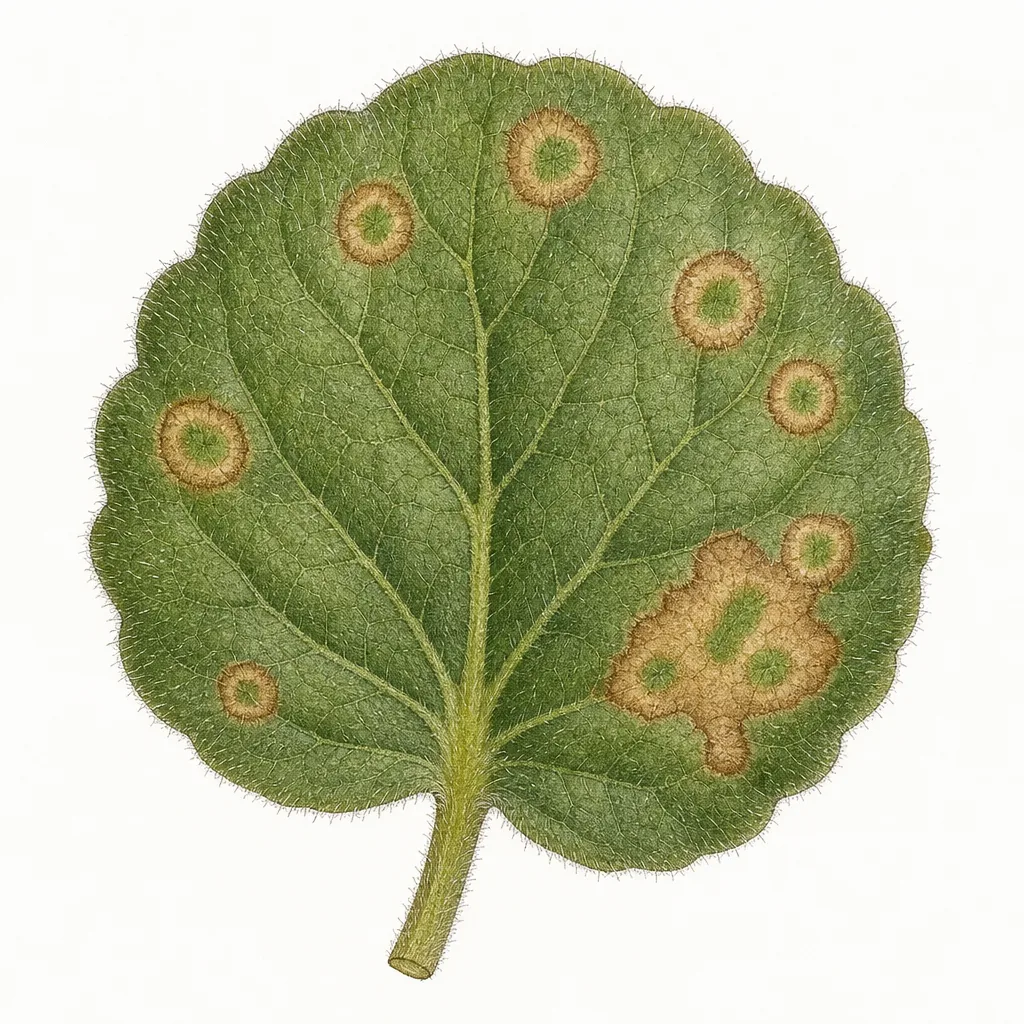
Brown spots on African violet leaves are most likely injury from cold watering splashes or strong direct sun, but rapidly enlarging wet spots or gray mold suggest disease.
Not sure it's this? Scan your plant — free
What it is
Leaf spotting is localized injury or death of leaf tissue, rather than one specific disease. In African violets, temperature shock from watering and excessive sunlight can damage patches of tissue; fungal infections can also cause spots and decay.
Also called: Leaf blotching, Cold-water ring spot, when caused by watering injury
Plants affected: African violets (Saintpaulia, now classified within Streptocarpus)
Symptoms
- Light-brown rings that sometimes merge into irregular patches can indicate watering injury.
- Brown or yellow blotches, sometimes with bleached areas, suggest excessive direct sunlight.
- Water-soaked spots that enlarge rapidly, especially with gray mold on leaves or flowers, suggest Botrytis blight.
Causes
- Water considerably colder than the leaves splashing onto foliage; a temperature difference of about 10°F can cause injury.
- Strong direct sunlight scorching exposed leaves.
- Botrytis infection, encouraged by humid conditions and poor air movement.
How to tell it apart
Match the pattern to recent care: rings after watering favor temperature injury; broad blotches on sun-exposed leaves favor scorch; rapidly expanding wet patches or gray fuzz favor disease. Sources emphasize different clues: Minnesota Extension links ordinary leaf spots to water left on leaves, while the RHS says brown or yellow blotches are usually sun damage. These are different possible causes, so color alone cannot settle the diagnosis.
- Botrytis blight
- Unlike simple splash injury, this infection causes rapidly enlarging water-soaked spots and may produce gray mold on leaves, leaf stalks and flowers.
- Root or crown rot
- Look for whole-plant wilting despite moist soil, rather than just isolated spots; affected roots may be brown, mushy and slimy.
- Cyclamen mite damage
- New center leaves become unusually hairy, hard, stunted and twisted, with corky injured areas—not simply flat brown patches on otherwise normal leaves.
Treatment
- 1. Check for spreading wet spots or mold Inspect the leaves and flowers today. If patches are wet-looking and enlarging, or gray mold appears, move crowded pots apart so air can circulate and avoid an enclosed, humid space. Contact your local university extension service this week for help identifying the problem before choosing a fungicide.
- 2. Change how you water At the next watering, use room-temperature water and direct it onto the potting mix, not the leaves. Alternatively, stand a pot with drainage holes in about 1 inch of room-temperature water; remove it when the soil surface feels moist and let it drain completely. Repeat only when the mix has become slightly dry, not on a fixed daily schedule.
- 3. Stop strong direct sun from reaching the leaves Today, move the plant into bright, indirect light or filter strong sunlight through a thin curtain. Keep it out of harsh direct sun while you watch for further damage.
- 4. Remove dead material This week, remove dead leaves and spent flowers with a small pointed pruner or tweezers. Brown patches will not turn green again; removing badly damaged leaves is optional for appearance, not a way to heal them.
Prevention
- Use room-temperature water every time and avoid splashing the fuzzy leaves.
- Provide bright, indirect light rather than strong direct sun.
- Use a pot with drainage holes and empty collected drainage water rather than leaving roots soaking.
- Keep temperatures steady, ideally within 60–80°F, and protect the plant from chilling conditions.
- Leave space between plants for air movement and remove dead leaves and spent flowers.
When to worry
Seek help promptly if spots enlarge rapidly, gray mold develops, or the plant wilts while its soil is moist. A collapsing plant with mushy, slimy roots may not survive; a few permanent splash or scorch marks alone do not indicate that kind of root failure.
Safety
Pesticides will not repair cold-water injury or sun scorch. If disease is suspected, get a diagnosis before selecting a fungicide. Follow the label for handling, protective equipment, use and storage of any product. Store products in their original labeled containers, away from children and pets, and keep children and pets away during treatment as directed by the label.
Sharing your home with pets or small children? See which plants our sources call safe for cats, dogs and kids.
FAQ
Will brown spots turn green again?
No. Injured leaf tissue does not turn green again; correcting care protects remaining and future growth.
Does getting water on the leaves always cause spots?
Not necessarily. Temperature matters: extension guidance particularly warns about water colder than the leaves. Using room-temperature water and keeping foliage dry reduces that risk.
Should I remove spotted leaves?
Remove dead leaves. You can also remove badly damaged leaves for appearance, but existing spots will not disappear if you leave them attached.
Are brown spots contagious?
Splash injury and sun scorch are environmental damage, not infections. Botrytis is a fungal disease, so rapidly spreading wet spots or gray mold need a different response.
Sources
- Growing African Violets — University of Georgia Cooperative Extension
- How to grow African violets — Royal Horticultural Society
- African Violet (Staintpaulia) — Texas Plant Disease Handbook
- African violets — University of Minnesota Extension
- African violet #854906 — University of Maryland Extension response on Ask Extension