
Powdery Mildew on Pumpkins: Causes and Fixes
Powdery mildew on pumpkins is most likely caused by airborne fungal spores that flourish in warm, humid canopies, which you can manage by pruning heavily coated leaves and applying protective organic fungicide sprays.
Not sure it's this? Scan your plant — free
What it is
Learn how to spot, treat, and prevent powdery mildew on pumpkins using pruning and gentle organic sprays to safeguard your vines and harvest.
Also called: Cucurbit powdery mildew, White mildew
Plants affected: Pumpkins, Winter squash, Summer squash, Zucchini, Cucumbers, Melons
Symptoms
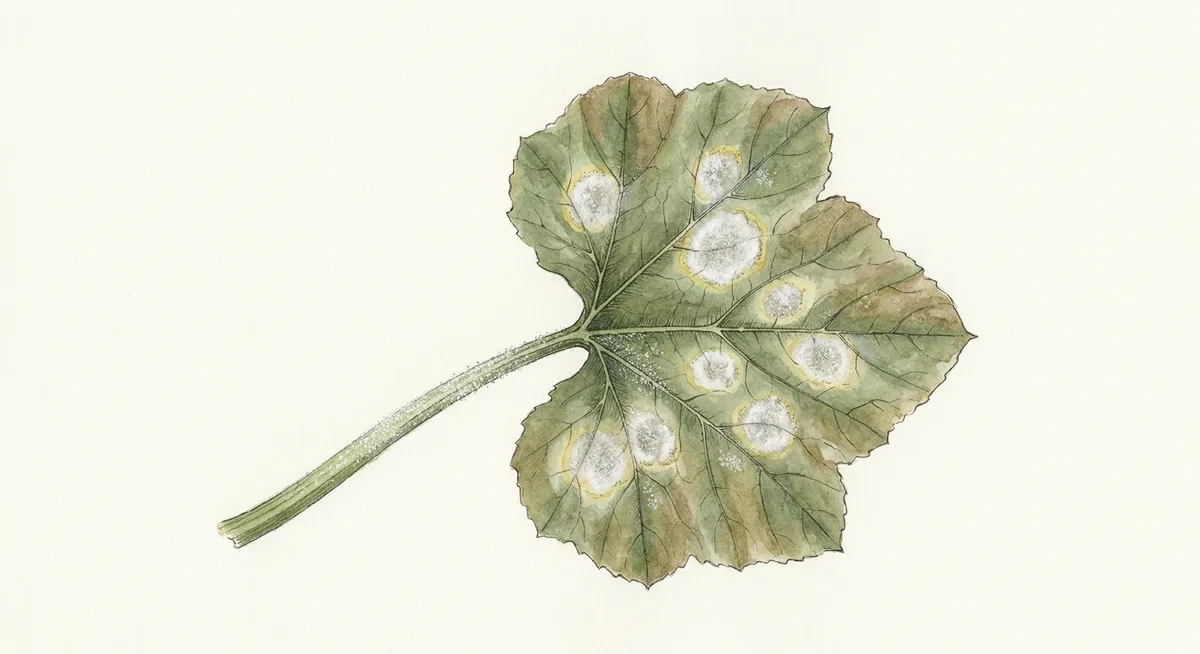
- Circular, dusty white or pale gray patches resembling talcum powder on leaf surfaces
- Spots expanding across entire leaves, leaf stems (petioles), and vine runners
- Lower, older leaves yellowing, turning brown, and shriveling into brittle foliage
- Premature leaf loss exposing pumpkins directly to sunscald
- Weakened, dry, or shriveled pumpkin handles (stems)
Causes
- Infection by fungal pathogens (most commonly Podosphaera xanthii or Golovinomyces cichoracearum)
- Lightweight fungal spores carried into the garden on air currents and wind
- Warm days (68°F to 80°F) combined with high relative humidity within dense vine growth
- Overcrowded planting or poor air circulation trapping moisture around the canopy
- Excess nitrogen fertilization producing dense, tender leaf growth highly susceptible to infection
How to tell it apart
Look closely at the oldest, most shaded leaves near the center of the hill. Powdery mildew starts as isolated, dusty white spots on both upper and lower leaf surfaces that readily wipe off when rubbed with a finger. Unlike natural leaf variegation, the powder sits on top of the leaf tissue and gradually spreads to coat leaf stems and vines.
- Downy mildew
- Downy mildew produces angular, blocky yellow patches on the upper leaf surface bounded strictly by leaf veins, with purplish-gray fuzzy mold on the underside, while powdery mildew forms round, powdery white spots that cover both sides of the leaf without being confined by veins.
- Natural leaf silvering or variegation
- Many pumpkin and winter squash varieties naturally display silvery-white mottling between leaf veins; these patterns are smooth, embedded within the leaf surface, and cannot be wiped off like fungal powder.
- Sunscald
- Sunscald causes bleached, paper-thin, dry tan or white dead patches on foliage and fruit surfaces exposed to harsh sunlight, lacking any talcum-like powdery coating or fungal spore growth.
Treatment
- Prune away the most heavily coated leaves Use clean hand pruners to cut off older, low-lying leaves where more than 50% of the surface is covered in white fungal dust. Bag and place these clippings in household trash rather than your compost pile to prevent spores from blowing back onto the garden. Removing them immediately reduces spore numbers and opens the interior canopy to light and breeze.
- Apply a horticultural oil or potassium bicarbonate spray Spray all remaining healthy leaves thoroughly, focusing on the undersides and lower canopy where powdery mildew colonies start. Mix the product according to package directions and spray early in the morning or during overcast weather when temperatures remain below 85°F to prevent leaf scorch. Reapply every 7 to 10 days to protect emerging foliage. For any pesticide, herbicide or fungicide say to follow the label and keep it away from pets and children.
- Alternate with a sulfur or biofungicide spray If disease pressure remains high, rotate in a sulfur fungicide spray or a biofungicide containing Bacillus amyloliquefaciens every 7 to 14 days. Never spray sulfur within 14 days of an oil application, and do not use sulfur when temperatures exceed 85°F to 90°F, as severe leaf burning can occur. For any pesticide, herbicide or fungicide say to follow the label and keep it away from pets and children.
- Adjust watering practices to keep foliage dry Water exclusively at the base of the pumpkin vines using a drip line or soaker hose early in the morning. Avoid overhead sprinklers, and clear any nearby weeds that restrict airflow around the base of the plants.
Prevention
- Select pumpkin cultivars bred for genetic resistance or tolerance to powdery mildew.
- Space pumpkin mounds 4 to 6 feet apart to maintain open air circulation throughout the vine canopy.
- Locate pumpkin patches in full sun where leaves dry rapidly after dew.
- Use soil-level drip irrigation or soaker hoses instead of overhead watering.
- Avoid applying high-nitrogen fertilizers that generate excess tender, dense foliage.
- Remove and dispose of all spent pumpkin vines and plant debris after harvest to prevent overwintering fungal structures.
When to worry
Do not worry if powdery mildew appears late in autumn when your pumpkins are already fully colored and rind-hardened, as vines naturally senesce at the end of the season. However, take immediate action if white patches appear in midsummer while fruit is still small and green; unchecked leaf loss at that stage halts fruit growth, triggers fruit sunburn, and shrivels the pumpkin handle.
Safety
Always wear protective gloves, long sleeves, and eye protection when handling or mixing horticultural oils, sulfur, or any garden fungicide. Store all products in their original tightly sealed containers in a cool, dry place out of reach of children and pets, and carefully follow the label instructions. Pumpkin foliage itself is non-toxic to people and pets, but if someone accidentally swallows or inhales garden chemicals, contact a doctor, a vet, or a poison line immediately.
FAQ
Can I still harvest and eat pumpkins from vines with powdery mildew?
Yes. The fungus stays on the leaf, stem, and handle surfaces and does not invade the pumpkin flesh. As long as the fruit rind is firm, unbroken, and free of rot, the pumpkin is completely safe to carve, cook, and eat.
Will powdery mildew spread from my pumpkins to my tomatoes or flowers?
Most likely not. Powdery mildew fungi are largely host-specific. The strains infecting cucurbits (such as pumpkins, squash, and melons) do not infect tomatoes, roses, or phlox, which are attacked by separate powdery mildew species.
Does baking soda work as a cure for powdery mildew on pumpkins?
Baking soda (sodium bicarbonate) can offer mild prevention by raising leaf surface pH, but sodium can accumulate in soil and burn pumpkin leaves. Horticultural potassium bicarbonate or sulfur sprays are far more effective and safer for the foliage.
Why does powdery mildew damage the pumpkin's handle?
The fungus attacks the petiole and fruit stem tissue directly, disrupting vascular flow and causing the stem to dry out, turn brittle, and snap off easily. Protecting stems with fungicides maintains a strong, green handle for harvest.