
Peace Lily Leaves Turning Brown at Tips: Causes and Fixes
Brown tips on peace lily leaves are most likely caused by erratic watering—letting the potting mix dry out completely until the plant droops before drenching it—or accumulated minerals and fluoride from tap water and fertilizers.
Not sure it's this? Scan your plant — free
What it is
Find out why your peace lily leaves are turning brown at the tips. Learn how to fix watering, flush built-up salts, and trim damaged leaves safely.
Also called: Tip burn, Leaf tip necrosis, Marginal leaf scorch, Brown leaf tips
Plants affected: Peace lily (Spathiphyllum species and hybrids)
Symptoms
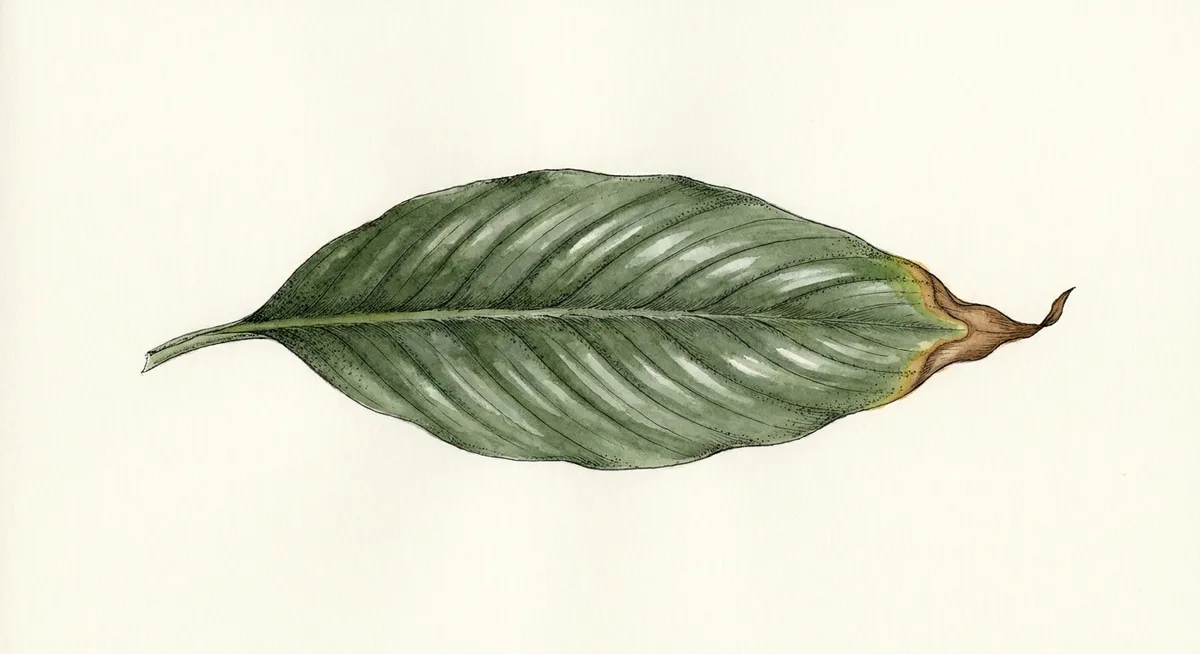
- Dry, crispy dark brown or black tips on mature leaves
- A thin yellowish band or halo separating the dead brown tip from healthy green tissue
- Browning that gradually creeps inward along the outer leaf margins
- Brittle or curling leaf points
- White, crusty mineral residue visible on the potting mix surface or along the pot rim
Causes
- Moisture stress: Letting the potting mix dry out to the point of severe wilting damages sensitive root hairs, preventing moisture from reaching the leaf extremities.
- Tap water chemicals and minerals: Spathiphyllum is particularly sensitive to fluoride, chlorine, chloramines, and dissolved mineral salts present in municipal and softened tap water.
- Fertilizer salt accumulation: Over-fertilizing or feeding a thirsty plant allows soluble salts to build up around the roots, pulling water away and scorching delicate leaf edges.
- Low indoor humidity: Air moisture below 40% to 50% pulls water out of thin leaf margins faster than the root system can replenish it.
- Direct sunlight or hot air currents: Warm drafts from heating registers or exposure to intense midday sun can rapidly scorch leaf tips.
How to tell it apart
Check the pattern of browning and your plant's recent routine. If only the sharp points of otherwise vibrant, green leaves are dry and papery, abiotic tip burn is the most probable culprit. Run a finger over the top two inches of soil—if it swings between bone-dry dust and waterlogged mud, uneven moisture is the likely driver. Inspect the soil surface and container rim: a pale, crusty chalking indicates mineral or fertilizer salt buildup. If browning forms soft, mushy, spreading blotches rather than crisp points, investigate disease or overwatering rather than simple tip burn.
- Root rot (waterlogged soil)
- Rather than crisp, isolated dry tips, root rot turns whole leaves yellow and then brown or black from the base upward, causing stems to become limp and mushy while roots turn dark, soft, and sour-smelling.
- Anthracnose leaf blight
- Anthracnose forms expanding, irregular dark tan or black lesions that can develop anywhere across the leaf surface and margins, often bordered by yellow tissue and sometimes exhibiting tiny fungal fruiting dots rather than clean, dry tip scorch.
- Sun scorch
- Sunlight burn creates bleached, pale, or papery tan patches across the broad center surfaces of upper leaves that face the light directly, rather than concentrating exclusively on the narrow tips.
- Natural leaf senescence (aging)
- Normal aging affects only the outermost, lowest leaves of the plant, turning the entire blade yellow and then brown over several weeks while all upper and central leaves remain completely green.
Treatment
- Flush accumulated mineral and fertilizer salts from the pot Take the plant to a sink, basin, or shower. Slowly pour room-temperature distilled water or rainwater through the potting soil—using roughly twice the volume of the container—letting it run freely out of the drainage holes for 1 to 2 minutes. Allow all excess water to drain out completely for 30 minutes before returning the pot to its saucer; never let the pot sit in drained runoff.
- Switch your watering source away from harsh tap water Begin watering exclusively with distilled water, reverse-osmosis filtered water, or clean rainwater. Avoid sodium-softened water entirely. Note that while leaving tap water out for 24 hours can help dissipate free chlorine, extension sources emphasize that it will not evaporate fluoride or chloramines.
- Establish an even moisture schedule Check the soil twice a week by inserting a finger 1 to 2 inches into the mix. Water thoroughly until water trickles from the drainage holes as soon as the top inch feels barely dry, rather than letting the plant collapse and wilt completely before giving it a drink.
- Trim unsightly dead tips Sanitize clean kitchen shears or pruning snips with 70% isopropyl alcohol. Carefully snip off the dead brown tip following the natural pointed shape of the leaf, leaving a hairline margin (about 1 millimeter) of brown tissue intact. Cutting into living green tissue creates a fresh wound that can trigger further browning.
- Raise ambient humidity and adjust placement Position the pot on a shallow tray filled with pebbles and water—ensuring the bottom of the pot sits entirely above the water level—or place an evaporative room humidifier nearby to maintain 50% to 60% relative humidity. Move the plant at least 4 to 6 feet away from forced-air heating vents, radiators, and drafty exterior doors.
Prevention
- Water when the top inch of potting soil feels dry to the touch, preventing the extreme drying-and-wilting cycles that trigger leaf tip collapse.
- Dilute balanced liquid houseplant fertilizer to one-quarter strength, apply it only to pre-moistened soil every 6 to 8 weeks during spring and summer, and stop feeding completely during fall and winter.
- Leach the potting container thoroughly with distilled water or rainwater every 3 to 4 months to rinse away latent fertilizer salts before they accumulate.
- Avoid placing your peace lily in direct sunlight or in the direct blowing path of heating and air conditioning registers.
- Wipe the large foliage monthly with a soft, damp cloth to remove household dust and support transpiration.
When to worry
Tip burn is primarily a cosmetic issue and does not threaten the plant's life on its own. However, you should worry if the browning rapidly marches down whole leaf stems, if new leaves unfurl completely black, or if the entire plant remains limp while the potting mix is wet. These signs point toward advanced fungal root rot or stem infection, requiring immediate root trimming and repotting into fresh, airy potting mix.
Safety
Peace lily (Spathiphyllum) contains insoluble calcium oxalate crystals. Chewing or swallowing any part of the plant causes severe mouth and throat irritation, burning, excessive drooling, and difficulty swallowing in humans, dogs, and cats. If ingested, contact a medical doctor, veterinarian, or a poison control center immediately. Keep the plant out of reach of pets and small children. If you use rubbing alcohol to sanitize pruning shears or apply houseplant fertilizers, keep them securely sealed in original containers, store them away from children and pets, and follow label directions.
FAQ
Will my peace lily's brown tips turn green again?
No. Once leaf tissue turns brown and dries out, the plant cells are dead and cannot regenerate. You can neatly snip away the brown parts using clean shears to restore the plant's appearance.
Should I cut off just the tip or the whole leaf?
Cut only the brown tip if the rest of the leaf blade is green and healthy, since the remaining leaf tissue still photosynthesizes to feed the plant. Only remove the entire leaf at the base of its stalk if more than half of it has died or turned yellow.
Does letting tap water sit out overnight remove fluoride?
No. Allowing water to sit out overnight lets chlorine gas dissipate, but fluoride, heavy minerals, and chloramines do not evaporate and remain concentrated in the water. If your municipal water is fluoridated, switch to rainwater or distilled water.
How can I tell if brown tips are from underwatering or overwatering?
Feel the soil and check the leaf texture: underwatering causes dry, papery, brittle tips accompanied by lightweight soil and dramatic wilting. Overwatering usually produces soft, dark brown to black tips, often bordered by yellowing lower leaves and heavy, waterlogged soil that smells faintly sour.
Sources
- Clemson University Cooperative Extension - Peace Lily Factsheet HGIC 1512
- Clemson University Cooperative Extension - Indoor Plants: Watering Factsheet HGIC 1459
- Clemson University Cooperative Extension - Houseplant Diseases & Disorders Factsheet HGIC 2251
- University of Minnesota Extension - Spring Houseplant Care
- lsuagcenter.com
- extension.org
- illinois.edu
- lowlightleaf.com